
The Hidden SEO Problem With AI Website Builders
Why many AI-generated websites remain invisible to Google, AI search engines, and potential customers.

Building a website has never been easier.
Modern AI tools like Lovable, Bolt, and v0 can generate a polished landing page in minutes. You describe your business, choose a style, click a button, and your website is online before you’ve written a single line of code.
For many people, that’s where the journey ends.
The site looks professional. The copy is in place. Everything loads quickly. Yet weeks later, almost nobody visits from Google. AI search engines rarely mention it. Organic traffic never arrives.
The obvious conclusion is usually that the content isn’t good enough.
In reality, the problem often starts much earlier.
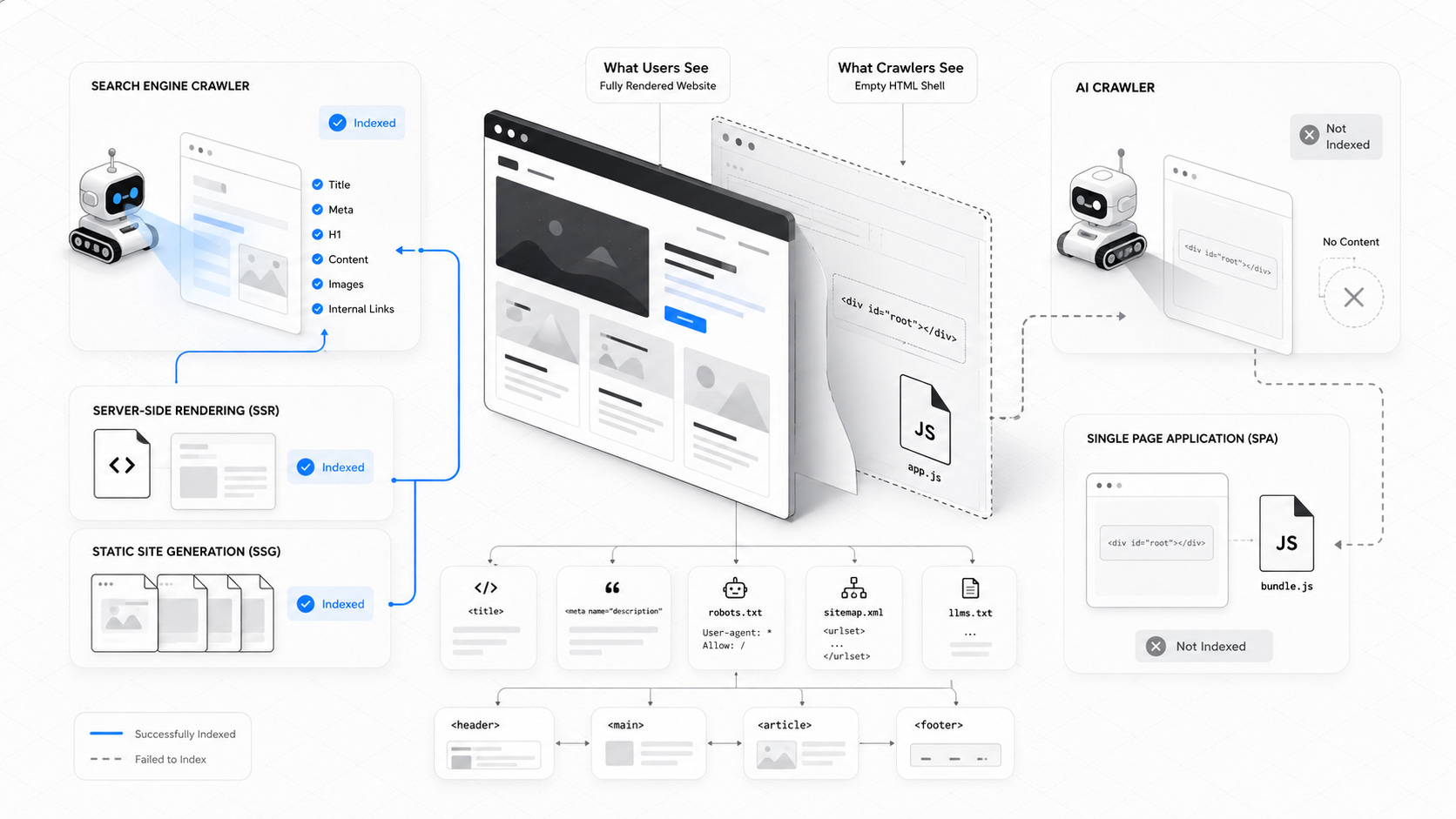
Many AI website builders produce applications that look perfect to visitors but expose very little content to search engine crawlers. If a bot can’t reliably read your pages, it can’t index them, rank them, or recommend them.
This isn’t a problem with AI itself.
It’s a consequence of how many AI-generated websites are built.
Understanding the difference between client-side rendering and server-side rendering can be the difference between a website that attracts customers and one that remains practically invisible.
Traditional Websites vs Modern AI-Generated Apps
Many people assume today’s web is built almost entirely with modern JavaScript frameworks.
The reality looks very different.
A huge portion of the internet still relies on technologies that have existed for decades. Traditional server-rendered websites, content management systems, and static HTML continue to power millions of businesses because they solve one problem exceptionally well: they deliver complete pages immediately.
Search engines love that.
Most AI website builders, however, take a different approach.
Instead of generating finished HTML pages, they often build Single Page Applications (SPAs). The browser downloads a mostly empty HTML document together with a large JavaScript bundle. Only after that JavaScript runs does the page become visible to the visitor.
For users, the experience feels fast and modern.
For search engines, it can become much more complicated.
SPA vs SSR
Understanding these two rendering models explains why many AI-generated websites struggle with SEO.
Single Page Applications (SPA)
A Single Page Application sends very little HTML to the browser.
The real page is assembled later by JavaScript.
A simplified example might look like this:
<!DOCTYPE html>
<html lang="en">
<head>
  <title>My Business</title>
</head>
<body>
  <div id="root"></div>

  <script type="module" src="/assets/index.js"></script>
</body>
</html>
The actual content, including headings, pricing, testimonials, and product descriptions, appears only after the JavaScript application has loaded.
For visitors, this usually isn’t a problem.
For crawlers, it can be.
Server-Side Rendering (SSR)
Server-side rendering works differently.
Instead of sending an empty shell, the server generates the complete HTML before returning the response.
When a browser requests the page, it immediately receives something like this:
<!DOCTYPE html>
<html lang="en">
<head>
  <title>Acme Design Studio</title>
  <meta
    name="description"
    content="Modern web design services for small businesses."
  />
</head>
<body>
  <header>
    <h1>Professional Website Design</h1>
  </header>

  <main>
    <p>
      We build fast, SEO-friendly websites for startups and local businesses.
    </p>

    <a href="/pricing">
      View Pricing
    </a>
  </main>
</body>
</html>
Everything important is already present.
Visitors see the page immediately.
Search engines can read it immediately.
JavaScript still loads afterward to add interactivity, but the essential content is already available.
Static Site Generation (SSG)
For marketing websites, blogs, documentation, and landing pages, there’s an even simpler option.
Static Site Generation creates every page during the build process instead of generating it for each request.
The generated files are ordinary HTML documents.
That means they are:
extremely fast
inexpensive to host
easy for search engines to crawl
ideal for websites where content doesn’t change every few seconds
Frameworks like Astro, Next.js, and Nuxt all support static generation alongside server rendering.
For most business websites, SSG provides the best balance between performance, simplicity, and SEO.
What Search Engines Actually Do
Before your website appears in search results, every search engine follows roughly the same workflow.
1. Crawling
A crawler discovers your page by following links or reading your sitemap.
2. Indexing
The crawler analyzes the page and decides what information should be stored in the search index.
3. Ranking
When someone performs a search, the engine decides whether your page deserves to appear among the results.
Everything depends on one simple requirement.
The crawler must be able to read your content.
What Does a Search Bot See?
Many developers check their website in a browser and assume everything is working correctly.
Search bots don’t experience the page the same way.
A quick test is to view the page source.
If the HTML looks like this:
<body>
  <div id="root"></div>

  <script src="/assets/index.js"></script>
</body>
there isn’t much for a crawler to analyze.
Your headlines, product descriptions, feature lists, pricing tables, customer reviews, and calls to action all exist only after JavaScript executes successfully.
If rendering fails for any reason, the crawler may index an almost empty page.
That’s one of the biggest reasons AI-generated websites often struggle to gain organic visibility.
Beautiful design doesn’t matter if search engines never receive the actual content in the first place.
Google Can Render JavaScript
Googlebot uses a modern Chromium-based rendering engine, so it can execute JavaScript and build client-side applications.
That sounds reassuring until you look at how the process actually works.
Google doesn’t render everything immediately.
It works in two stages.
First, Google downloads and analyzes the raw HTML.
Only later does it place the page into a rendering queue, where JavaScript is executed and additional content is discovered.
Request page
      │
      ▼
Download HTML
      │
      ▼
Initial indexing
      │
      ▼
Rendering queue
      │
      ▼
Execute JavaScript
      │
      ▼
Discover additional content
      │
      ▼
Update index
Although Google’s rendering pipeline has become much faster over the years, JavaScript rendering is still more expensive than parsing plain HTML.
Every rendered page consumes additional CPU time and resources.
For established websites, that usually isn’t a major concern.
For a brand-new website with little authority, it creates unnecessary risk.
If rendering fails because of a JavaScript error, a broken API request, or a slow response, Google may end up indexing a page with little or no meaningful content.
That’s one of the reasons server-rendered websites often gain visibility faster.
Why AI Website Builders Default to SPAs
If server rendering is so important, why do AI website builders keep producing Single Page Applications?
The answer is surprisingly simple.
SPAs are the easiest type of application to generate.
Modern React projects created with tools like Vite have become one of the most common code patterns on GitHub. Large language models have learned from millions of similar repositories.
Generating a React SPA is predictable.
Generating a complete production-ready SSR application is significantly more complex.
Most AI builders are optimized for speed.
Their goal is to create an attractive website in minutes, not necessarily the most search-friendly one.
As a result, many generated projects look fantastic while hiding nearly all meaningful content behind JavaScript.
The website impresses visitors.
Search engines see very little.
Beautiful Doesn’t Mean Searchable
This is where many business owners become frustrated.
The landing page looks polished.
Animations are smooth.
Performance scores are high.
Everything appears to work perfectly.
Then weeks pass without organic traffic.
The issue usually isn’t the design.
It’s that the most important information only exists after JavaScript runs.
For humans, that’s invisible.
For search engines, it can be the difference between ranking on the first page and never appearing at all.
AI Search Makes the Problem Even Bigger
Traditional search engines are only part of today’s search landscape.
Millions of users now ask ChatGPT, Perplexity, Copilot, or Gemini to recommend products, services, and websites instead of opening Google first.
These systems rely on their own crawlers.
And most of those crawlers behave very differently from Googlebot.
Research published by Vercel and MERJ found that most major AI crawlers either download JavaScript without executing it or ignore it entirely.
That includes crawlers associated with:
ChatGPT
Claude
Perplexity
Meta
ByteDance
The main exceptions are Gemini, which benefits from Google’s rendering infrastructure, and Applebot, which has its own browser-based crawler.
For everyone else, the HTML response is often the only version of your website they ever see.
If your homepage looks like this before JavaScript runs...
<body>
  <div id="root"></div>

  <script src="/assets/app.js"></script>
</body>
...then that’s effectively the version many AI systems receive.
No pricing.
No product descriptions.
No testimonials.
No services.
No competitive advantages.
Just an empty container waiting for JavaScript that may never execute.
That means your website can look perfect to visitors while remaining almost invisible to both traditional search engines and the growing number of AI-powered search platforms.
What Is llms.txt?
As AI-powered search becomes more common, you’ve probably come across a file called llms.txt.
Some developers describe it as robots.txt for AI.
Others call it a sitemap for language models.
Neither description is completely accurate.
The idea is much simpler.
llms.txt is a plain Markdown document placed in the root of your website that explains what your project is about and points AI systems toward your most important pages.
A minimal example looks like this:
# Acme Design Studio

> We build fast, SEO-friendly websites for small businesses.

## Services

- Website Development
- SEO Consulting
- Performance Optimization

## Important Pages

- https://example.com/services
- https://example.com/pricing
- https://example.com/blog
Unlike HTML, it contains no navigation menus, scripts, advertisements, or complex layouts.
It’s simply structured information that’s easy for both humans and machines to read.
Does llms.txt Actually Work?
This is where expectations and reality diverge.
At the time of writing, there is very little evidence that major search engines or AI assistants rely on llms.txt when discovering or ranking websites.
Google has publicly stated that the format doesn’t influence Search or AI search features.
Industry studies have reached similar conclusions.
Many websites publish the file, yet almost none receive measurable traffic from it.
That doesn’t necessarily make it useless.
The file is inexpensive to maintain, easy to generate, and some developer-focused tools already use it when working with documentation.
Several well-known technology companies also publish llms.txt as a low-cost investment in case the format becomes more widely adopted.
The important point is this:
llms.txt is not a replacement for proper HTML.
If an AI crawler can’t read your website, a separate text file won’t fix the problem.
The page itself still needs to expose meaningful content.
Choosing the Right Rendering Strategy
Every rendering approach has its place. The right choice depends on what you’re building, not what’s currently popular.
Single Page Applications (SPA) work best for software that users interact with after logging in. Dashboards, admin panels, CRMs, project management tools, and other highly interactive applications benefit from client-side rendering because users spend most of their time inside the app rather than arriving from search engines.
Server-Side Rendering (SSR) is a better fit for websites whose content changes frequently. Online stores, news websites, product catalogs, and marketplaces all benefit from generating HTML on the server so both visitors and search engines receive complete pages immediately.
Static Site Generation (SSG) is often the ideal choice for marketing websites, landing pages, blogs, documentation, portfolios, and company websites. The pages are generated during the build process, making them extremely fast, inexpensive to host, and easy for search engines to crawl.
If your primary goal is attracting visitors through Google or AI search, server-rendered or statically generated pages are almost always the better option.
SEO Checklist for AI-Generated Websites
Before publishing an AI-generated website, verify these fundamentals.
Make sure every page has unique metadata
Each page should include a meaningful title and meta description written by a human.
Avoid generic placeholders generated by AI.
Generate real HTML
Open your website’s source code.
If the important content isn’t visible there, search engines may struggle to index it.
A quick command-line check works too.
curl https://example.comThe returned HTML should already contain:
headings
body text
links
metadata
If everything appears only after JavaScript runs, reconsider your rendering strategy.
Create a sitemap
Every public website should publish a valid sitemap.xml.
It helps crawlers discover pages more efficiently.
Configure robots.txt
Double-check that important crawlers aren’t accidentally blocked.
Misconfigured robots rules are surprisingly common.
Use semantic HTML
Good HTML benefits both accessibility and search engines.
Prefer meaningful elements such as:
<header>
<main>
<article>
<section>
<nav>
<footer>
Instead of relying entirely on generic <div> elements.
Add structured data
Schema.org markup helps search engines better understand your content.
Useful schemas include:
Organization
LocalBusiness
Product
Article
FAQ
Review AI-generated copy
AI can produce readable content quickly, but it often lacks specificity and expertise.
Rewrite important sections in your own voice.
Clear, trustworthy writing benefits both users and search engines.
If You Prefer Building SPAs
Sometimes a Single Page Application is still the right technical choice.
That’s perfectly reasonable.
In those cases, consider reducing SEO risks.
You can:
pre-render public pages
generate static snapshots
use SSR for marketing pages
keep the interactive application behind authentication
Many modern frameworks make this hybrid approach straightforward.
You don’t have to choose between a fully static website and a fully client-rendered application.
Final Thoughts
AI website builders have dramatically lowered the barrier to creating websites.
That’s a genuine advantage.
The problem isn’t the tools.
It’s assuming that a beautiful interface automatically becomes a discoverable website.
Search engines and AI assistants don’t evaluate your application the same way people do.
They first need access to meaningful HTML.
Without it, your content may never reach the index, no matter how polished the design looks.
The easiest fix often takes just one sentence in your prompt:
Build this website using SSR or Static Site Generation, with SEO-friendly HTML rendered on the server.
That single instruction can make the difference between a website that’s easy to find and one that remains invisible to both traditional search engines and the growing ecosystem of AI-powered search.