

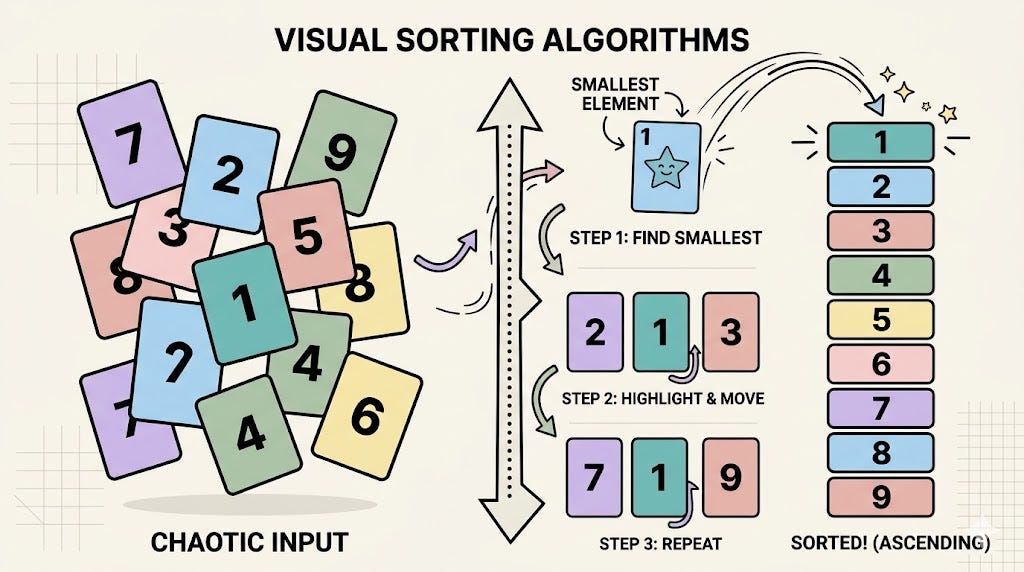
Algorithms often sound more intimidating than they really are.
Someone says sorting algorithm and many people immediately imagine:
scary computer science lectures
mathematical notation
Big-O formulas everywhere
complicated whiteboard interviews
But most beginner algorithms are surprisingly ordinary once you strip away the terminology.
Selection sort is a perfect example.
Its entire strategy can be explained using something you already do naturally in everyday life:
find the best candidate, put it where it belongs, then repeat.
That’s all.
No magic.
No hidden computer science ritual.
Let’s make it visual.
Imagine Cleaning a Messy Desk

Suppose your desk is covered with books.
Not organized.
Not stacked nicely.
Just chaos.
You want to arrange them from thinnest to thickest.
Your pile looks like this:
[ thick ] [ medium ] [ tiny ] [ huge ] [ thin ]How would a human solve this?
Probably like this:
Look through all books.
Find the thinnest one.
Put it in the first position.
Ignore it forever.
Repeat with the remaining books.
That process is selection sort.
The algorithm’s name suddenly becomes very literal.
You’re simply selecting the best candidate during each round.
The Core Mental Model
Selection sort quietly divides your array into two invisible regions.
Think of the data as having two zones:
Sorted Part | Unsorted PartAt the beginning:
[] | [64, 25, 12, 22, 11]Nothing is sorted yet.
Everything belongs to the unsorted zone.
Each round follows the same pattern:
search the unsorted section
find the smallest value
move it into position
expand the sorted section
Simple.
Predictable.
Repeatable.
Walking Through a Real Example
Let’s sort this array:
const values = [64, 25, 12, 22, 11];Round 1
Current state:
[] | [64, 25, 12, 22, 11]Search for the smallest value.
Scan through everything:
64 → 25 → 12 → 22 → 11Smallest value:
11Move it to the front.
Result:
[11] | [25, 12, 22, 64]The first slot is finished forever.
We never need to touch it again.
Round 2
Ignore the sorted section.
Focus only on:
[25, 12, 22, 64]Search again.
Smallest value:
12Swap it into place.
Result:
[11, 12] | [25, 22, 64]Two positions solved.
Round 3
Remaining section:
[25, 22, 64]Find the smallest:
22Swap.
Now we have:
[11, 12, 22] | [25, 64]Round 4
Remaining numbers:
[25, 64]Smallest value?
Already:
25No swap required.
Final result:
[11, 12, 22, 25, 64]Done.
No mystery.
Just repetition.
Writing Selection Sort in JavaScript
Now that the behavior feels intuitive, the implementation becomes much easier to understand.
Here’s a clean version.
function selectionSort(items) {
  const result = [...items];

  for (let boundary = 0; boundary < result.length - 1; boundary++) {
    let smallestIndex = boundary;

    for (let cursor = boundary + 1; cursor < result.length; cursor++) {
      if (result[cursor] < result[smallestIndex]) {
        smallestIndex = cursor;
      }
    }

    if (smallestIndex !== boundary) {
      [result[boundary], result[smallestIndex]] = [
        result[smallestIndex],
        result[boundary],
      ];
    }
  }

  return result;
}

const numbers = [64, 25, 12, 22, 11];

console.log(selectionSort(numbers));
Output:
[11, 12, 22, 25, 64]Understanding the Algorithm Step by Step
Let’s slow down and unpack what’s actually happening.
The Outer Loop
The outer loop controls rounds.
Each round permanently solves exactly one position.
Think of it like this:
Round 1 → fill slot 0
Round 2 → fill slot 1
Round 3 → fill slot 2
Each iteration grows the sorted region.
The Inner Loop
The inner loop performs the search.
Its only responsibility:
find the smallest remaining value.
It scans the unsorted section and continuously updates the current minimum.
Imagine somebody repeatedly saying:
“This is the smallest thing I’ve seen so far.”
Then:
“Wait, this one is smaller.”
Then:
“Nope, this one wins.”
By the end of the scan, you know exactly which element belongs next.
Making Selection Sort Visual in JavaScript
Reading algorithms is useful.
Watching them evolve is even better.
Let’s log every round.
function visualizeSelectionSort(values) {
  const array = [...values];

  for (let start = 0; start < array.length - 1; start++) {
    let minIndex = start;

    for (let scan = start + 1; scan < array.length; scan++) {
      if (array[scan] < array[minIndex]) {
        minIndex = scan;
      }
    }

    if (minIndex !== start) {
      [array[start], array[minIndex]] = [
        array[minIndex],
        array[start],
      ];
    }

    console.log(`Round ${start + 1}:`, [...array]);
  }
}

visualizeSelectionSort([64, 25, 12, 22, 11]);
Console output:
Round 1: [11, 25, 12, 22, 64]
Round 2: [11, 12, 25, 22, 64]
Round 3: [11, 12, 22, 25, 64]
Round 4: [11, 12, 22, 25, 64]
This is where algorithms often become satisfying.
You can literally watch order emerge.
Why Selection Sort Is Slow
Selection sort is simple.
But simplicity has a cost.
Even if your array is already perfectly sorted:
[1, 2, 3, 4, 5]The algorithm still performs almost the same amount of scanning.
It keeps searching.
It keeps comparing.
It does not become dramatically smarter.
Time complexity:
Best case: O(n²)
Average case: O(n²)
Worst case: O(n²)
That consistency is selection sort’s biggest weakness.
Faster algorithms like quicksort or mergesort can outperform it dramatically on large datasets.
Where Selection Sort Still Makes Sense
You probably won’t use selection sort for processing millions of records.
That’s okay.
Not every algorithm exists to dominate benchmarks.
Selection sort still shines in a few areas.
Learning Core Programming Ideas
Selection sort teaches important programming concepts:
nested loops
boundaries
searching
state reduction
incremental problem solving
That’s incredibly valuable for beginners.
Small Data Sets
Tiny arrays.
Lightweight utilities.
Simple scripts.
Sometimes readability matters more than raw performance.
Low-Memory Scenarios
Selection sort uses:
O(1)extra space.
It sorts in place.
No helper arrays required.
That property can still matter in certain environments.
Why Visual Learning Changes Everything
Many algorithm tutorials start from code.
That’s often backwards.
Beginners end up memorizing syntax before understanding behavior.
A smoother learning path looks like this:
Understand the movement.
Understand the strategy.
Understand the implementation.
Selection sort becomes much less abstract once you visualize the process.
You’re not really sorting numbers.
You’re solving a shrinking problem.
Each round removes uncertainty.
Each round reduces chaos.
Each round makes the remaining task smaller.
That’s a powerful programming pattern you’ll encounter far beyond sorting algorithms.
Final Thoughts
Selection sort will not power massive search engines.
It will not replace highly optimized production sorting algorithms.
But that was never its real purpose.
Selection sort teaches a much more important lesson:
solve one small piece completely, then move forward.
Find the smallest value.
Place it.
Shrink the problem.
Repeat.
Simple.
Visual.
Surprisingly elegant.
And an excellent way to start thinking like a programmer.