
JavaScript Just Leveled Up: ES2025 - You’ll Fall in Love With
JavaScript Just Got Beautiful — The New ES2025 Syntax Revolution

As front-end developers, staying ahead of JavaScript’s evolution isn’t optional — it’s survival.
When the ES2025 proposals dropped, many developers (myself included) were shocked. JavaScript could finally be written like poetry — expressive, readable, and ridiculously elegant.
Let’s explore some of these groundbreaking new features that are shaping the next generation of JS.
🎯 Pattern Matching — Goodbye if/else Hell
Tired of endless conditionals?
Pattern matching transforms branching logic into declarative expressions.
Old approach:
function handleResponse(response) {
  if (response.status === 200 && response.data) {
    return response.data;
  } else if (response.status === 401) {
    throw new Error(’Unauthorized’);
  } else if (response.status === 404) {
    throw new Error(’Not Found’);
  } else if (response.status >= 500) {
    throw new Error(’Server Error’);
  } else {
    throw new Error(’Unknown Error’);
  }
}
New ES2025 magic:
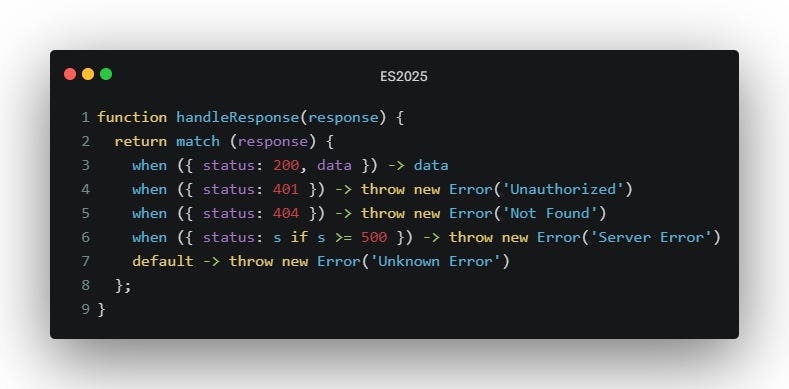
function handleResponse(response) {
  return match (response) {
    when ({ status: 200, data }) -> data
    when ({ status: 401 }) -> throw new Error(’Unauthorized’)
    when ({ status: 404 }) -> throw new Error(’Not Found’)
    when ({ status: s if s >= 500 }) -> throw new Error(’Server Error’)
    default -> throw new Error(’Unknown Error’)
  };
}
It’s concise, readable, and surprisingly powerful — like switch statements on steroids.
Array pattern matching:
const analyzeArray = (arr) => match (arr) {
  when ([]) -> “Empty array”
  when ([x]) -> `Single element: ${x}`
  when ([x, y]) -> `Two elements: ${x}, ${y}`
  when ([first, ...rest]) -> `First: ${first}, Remaining: ${rest.length}`
};
🚀 Pipeline Operators — Fluent, Elegant Data Flow
The pipeline operator |> lets you chain operations without deep nesting.
Old way (callback spaghetti):
const result = encodeURIComponent(
  JSON.stringify(
    Object.values(
      Object.fromEntries(
        Object.entries(data).filter(([k, v]) => v != null)
      )
    )
  )
);
ES2025 way:
const result = data
  |> Object.entries(%)
  |> (%.filter(([k, v]) => v != null))
  |> Object.fromEntries(%)
  |> Object.values(%)
  |> JSON.stringify(%)
  |> encodeURIComponent(%);
Readable. Linear. Beautiful.
And yes — it supports async pipelines too!
🔒 Record & Tuple — True Immutable Data Structures
Finally, native immutability without libraries like Immutable.js.
// Record — immutable object
const user = #{
  id: 1,
  name: “Alice”,
  profile: #{
    age: 25,
    email: “alice@example.com”
  }
};

// Tuple — immutable array
const settings = #[”dark”, “en-US”, true];
Records and Tuples compare by value, not by reference:
#{ x: 1, y: 2 } === #{ x: 1, y: 2 } // true!In React:
const UserCard = React.memo(({ user }) => {
  const processed = #{
    ...user,
    displayName: `${user.firstName} ${user.lastName}`
  };
  return <div>{processed.displayName}</div>;
});
No useMemo, no shallow comparison headaches.
💰 Decimal Type — Precision You Can Bank On
No more 0.1 + 0.2 !== 0.3 memes.
const total = 0.1m + 0.2m; // 0.3m
const tax = 19.99m * 0.08m; // 1.5992m

function calculateOrder(price, qty, taxRate) {
  const subtotal = price * qty;
  const tax = subtotal * taxRate;
  return (subtotal + tax).round(2);
}
The new Decimal type (m suffix) gives exact arithmetic — crucial for finance, billing, and scientific calculations.
🔄 Iterator Helpers — Superpowers for Generators
function* fibonacci() {
  let [a, b] = [0, 1];
  while (true) { yield a; [a, b] = [b, a + b]; }
}

const evenSquares = fibonacci()
  .take(20)
  .filter(n => n % 2 === 0)
  .map(n => n ** 2)
  .toArray();
Readable streaming, chainable processing, and lazy evaluation — finally built-in.
📦 Secure Module Imports — Explicit and Type-Safe
import config from ‘./config.json’ with { type: ‘json’ };
import styles from ‘./styles.css’ with { type: ‘css’ };
import wasmModule from ‘./algo.wasm’ with { type: ‘wasm’ };
Supports conditional and environment-based imports:
const config = await import(
  `./config-${process.env.NODE_ENV}.json`,
  { with: { type: ‘json’ } }
);
🛡️ Try Expressions — Elegant Error Handling
const data = try fetchUserData(userId) catch (err) {
  console.warn(’Failed to fetch user:’, err);
  return getDefaultUser();
};
Functional, concise, and expressive — no need for nested try/catch.
⏰ Temporal API — The End of Date() Confusion
Finally, JavaScript dates that make sense.
const now = Temporal.Now.instant();
const birthday = Temporal.PlainDate.from(’2024-01-15’);
const meeting = Temporal.ZonedDateTime.from(’2024-12-25T10:30:00[Asia/Shanghai]’);
const nextWeek = now.add({ days: 7 });
It’s like Luxon and Day.js, but native.
🎨 Smarter Template Strings — Write HTML, SQL, and Styles Safely
const renderHTML = (title, content) => html`
  <div class=”container”>
    <h1>${title}</h1>
    <div>${content}</div>
  </div>
`.dedent();
They now support auto indentation removal, safe variable insertion, and context-specific escaping for HTML, SQL, and CSS templates.
💡 Practical Tips for Adopting ES2025
Start small: Try pipeline operators and pattern matching first.
Use Babel plugins: Many features can be used today via transformations.
Train your team: Modern syntax means modern mental models.
Use TypeScript: Combine these features with static typing for the ultimate developer experience.
🧭 The Future Is Already Here
ES2025 is more than a syntax upgrade — it’s a mindset shift.
Cleaner, safer, and more expressive code will change how we reason about logic and structure.
JavaScript just became beautifully powerful.
Now it’s your turn to write it that way.
What useless AI slop.
TL;DR, what Liam said
⚠️ Hey folks the misinformation here is real!
The proposal for records was withdrawn on 14th April.
Other misinformation is also present, the less you read from this article the better.